Materialists: Sometimes Time Doesn’t Heal — It Just Teaches You How to Hide It
When dysfunction is your first language, peace sounds foreign

Content warning — there will be spoilers about the film Materialists.
You know how people say we love what we know — or more painfully, what knows us. That our hearts don’t choose the best option, but the most familiar one. I kept thinking about that watching Materialists, especially something Dakota Johnson said in an interview: that her character, Lucy, had to choose between her “ideal love” and her “ideal lifestyle.” And even though her “ideal love” had already failed her very deeply and destructively, she still chose it. She still chose him. John. The chaos.

And I sat there thinking: how? Why couldn’t she choose Harry — Pedro Pascal’s character — who was steady, gentle, deeply intuitive, rich (and not just with money)? But I think the answer is this: we return to chaos not because we like it, but because we’ve made peace with it. Chaos feels like home when it’s the only version of love you’ve ever known. If love has always come wrapped in unpredictability, distance, apology, or fear — then comfort feels suspicious, kindness feels foreign, and peace? Boring.
We don’t always break the cycle. Sometimes we just learn how to sit quietly inside it.
And that’s where Lucy lives. Her parents’ marriage was broke — not just financially, but emotionally — and her relationship with John was a repeat of that dynamic. Tense, disjointed, intoxicating. But it was known. That’s what matters. Harry, on the other hand, offered a life that required her to become someone new — someone still, someone stable. But you can't always trust stillness when your nervous system is wired for survival.
There’s a quote I keep circling back to — “If you grow up with an angry man in the house, you will always have one. And if you can't find him, it's probably you.” It lives in my bones. That kind of generational emotional chaos doesn’t vanish when you become an adult — it hides. It shapeshifts. And I think Lucy knew that if she chose Harry, she would have become the angry one. The unsettled one. The one quietly unraveling in a calm, beautiful apartment full of things she didn’t trust

.
Because when all you’ve ever known is instability, you start to believe that peace is a performance. And chaos? Chaos is the truth. So she went back to John. Not because he was good for her, but because he matched the ache she’d spent her whole life rehearsing.
Time didn’t heal Lucy. It just taught her how to compartmentalize — how to tuck the trauma away and call it memory. And when you don’t unpack what broke you, you’ll always go back to the place where you first cracked, thinking this time you’ll fix it. This time, you’ll make it stay. This time, maybe, it won’t hurt.
But it does. It always does.
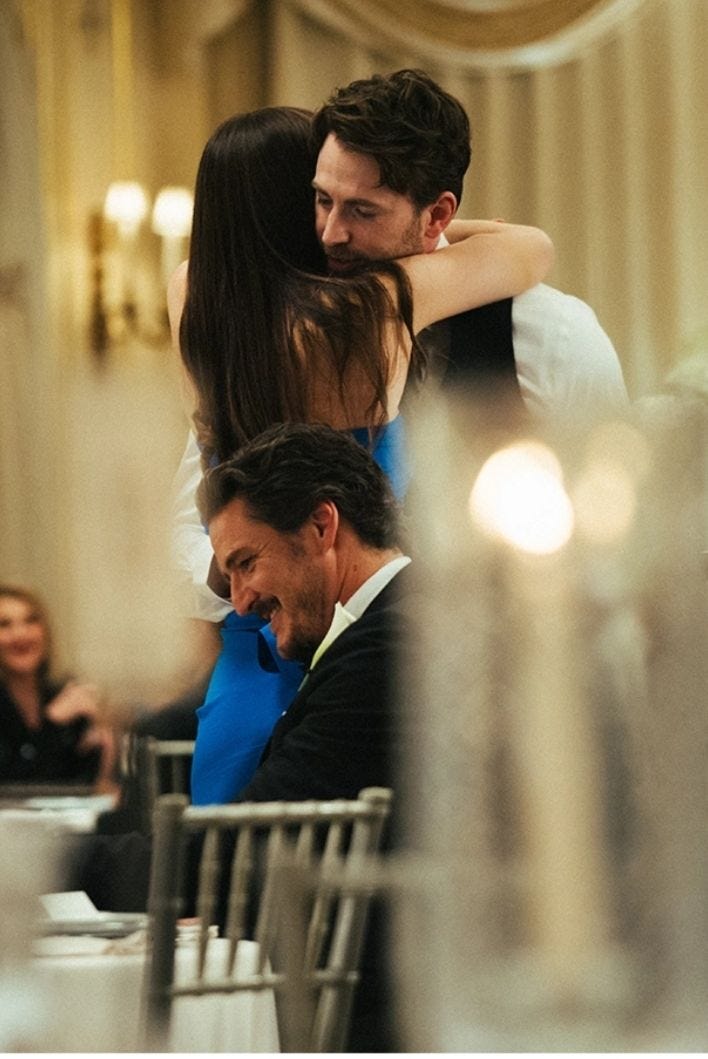
And Materialists doesn’t try to redeem that. It doesn’t moralize her decision or offer a lesson in self-love or “choosing better.” Instead, it ends quietly — with a City Hall marriage, shot from a distance, like a memory already fading. No grand speeches. No romantic crescendo. Just two people returning to what they know.
Some might call that tragic. Some might call it love. But maybe it's just human.
I think about how many of us end up in relationships where we love people through their damage because it matches our own. Not because it’s good for us — but because it doesn’t scare us. Peace is terrifying when you’re used to panic. And sometimes, the scariest thing in the world is being loved gently.

It’s a harsh reality.
Humans will always pick what they know - good or bad - as long as they have some degree of certainty.
Nobody likes a surprise. We desire autonomy.
That’s why she didn’t choose Harry. Harry represented a new perspective and uncertain perspectives. John represented a life she was used to and knew what to expect.
And John was it for her.